Books
On the Semicivilized
Coloniality, Finance, and Embodied Sovereignty in Cairo
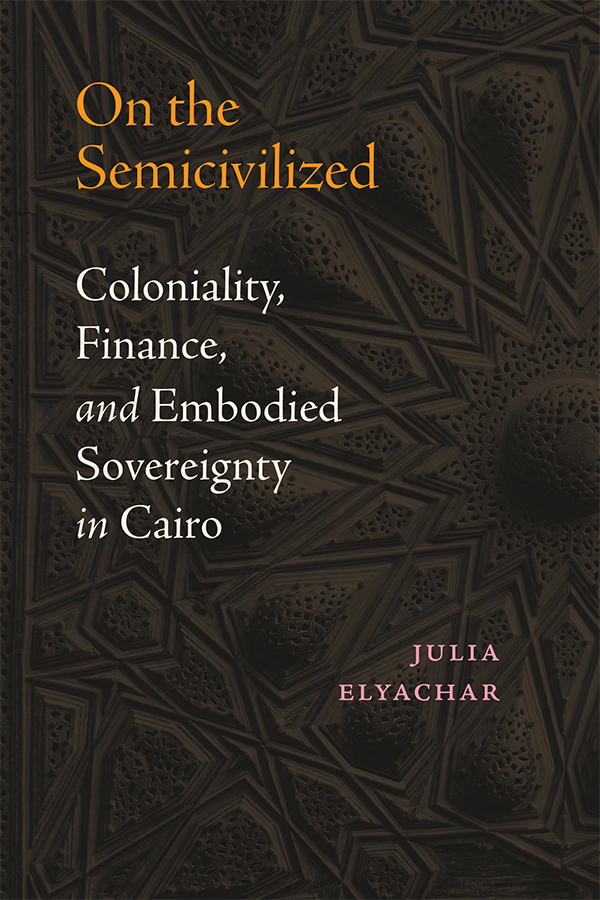
On the Semicivilized
Coloniality, Finance, and Embodied Sovereignty in Cairo
On the Semicivilized is a sweeping analysis of the coloniality that shaped—and blocked—sovereign futures for those dubbed barbarian and semicivilized in the former Ottoman Empire.
Drawing on thirty years of ethnographic research in Cairo, family archives from Palestine and Egypt, and research on Ottoman debt and finance, Elyachar theorizes a global condition of the “semicivilized” marked by nonsovereign futures, crippling debts, and the constant specter of violence exercised by those who call themselves civilized, inviting us to rethink catastrophe and potentiality in Cairo and the world today.
More about On the Semicivlized
Markets of Dispossession
NGOs, Economic Development, and the State in Cairo
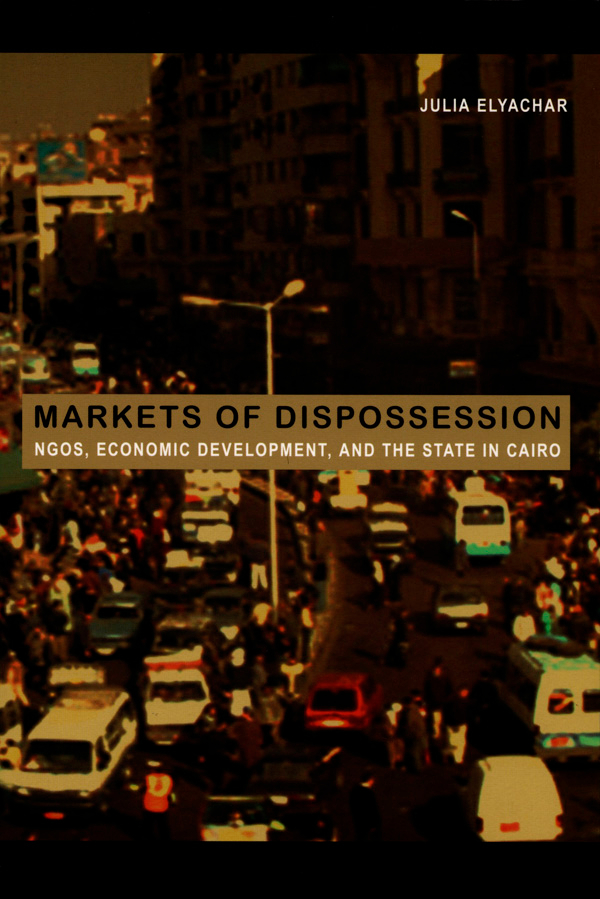
Markets of Dispossession
NGOs, Economic Development, and the State in Cairo
What happens when the market tries to help the poor? In many parts of the world today, neoliberal development programs are offering ordinary people the tools of free enterprise as the means to well-being and empowerment. Schemes to transform the poor into small-scale entrepreneurs promise them the benefits of the market and access to the rewards of globalization. Markets of Dispossession is a theoretically sophisticated and sobering account of the consequences of these initiatives.
More about Markets of Dispossession
Thinking Infrastructures
Research in the Sociology of Organizations, vol. 62
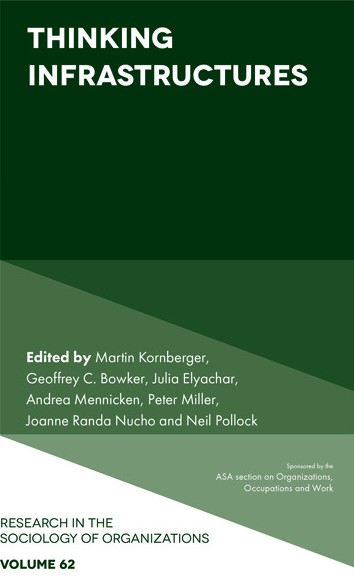
Thinking Infrastructures
Research in the Sociology of Organizations, vol. 62
This volume introduces the notion of Thinking Infrastructures to explore a broad range of phenomena that structure attention, shape decision-making, and guide cognition: Thinking Infrastructures configure entities (via tracing, tagging), organise knowledge (via search engines), sort things out (via rankings and ratings), govern markets (via calculative practices, including algorithms), and configure preferences (via valuations such as recommender systems). Thus, Thinking Infrastructures, we collectively claim in this volume, inform and shape distributed and embodied cognition, including collective reasoning, structuring of attention and orchestration of decision-making.
View Thinking Infrastructures on Emerald Publishing
Selected articles and chapters
See my CV for a full list of articles, chapters in edited volumes, collections, and other publications.
Banking, Debt, Finance
- Elyachar, Julia, Bandelj, Nina, Richardson, Gary, and Weatherall, James Owen “Comprehending and Regulating Financial Crisis.” Perspectives on Science 24, no. 4 (2016): 443–473.Banking, Debt, FinanceLink
- Elyachar, Julia, Bandelj, Nina, Boston, Tyler, Kim, Julie, McBride, Michael, Tufail, Zaibu, and Weatherall, James Owen “Morals and Emotions of Money.” In Money Talks: Explaining how Money Really Works, Princeton University Press, 2017.Banking, Debt, FinanceLink
- “Regulating Crisis: A Retrospective Ethnography of the 1982 Latin American Debt Crisis at the New York Federal Reserve Bank.” Valuation Studies 1, no. 2 (2013): 147–160.Banking, Debt, FinanceLink
Embodiment, Proprioception, Mobility
- “Anthropology of Proprioception: Endurance and Collectivity on Unstable Grounds in Post-Revolutionary Cairo.” American Anthropologist 124, no. 3 (2022): 525–535.Embodiment, Proprioception, MobilityLink
- “Phatic Labor, Infrastructure, and the Question of Empowerment in Cairo.” American Ethnologist 37, no. 3 (2010): 453–464.Embodiment, Proprioception, MobilityLink
Infrastructure
- “Thinking Infrastructures: Introduction.” In Thinking Infrastructures, Edited by Julia Elyachar, Martin Kornberger, Neil Pollock, Geoffrey Bowker, Joanne Nucho, Emerald Publishing Limited, 2019.InfrastructureLink
- “Upending Infrastructure in Times of Revolt.” In Distributed Agency, Edited by Paul Kockelman, Nick Enfield, Oxford University Press, 2017: 49–56.InfrastructureLink
Neoliberalism
- “Empowerment Money: The World Bank, Non-Governmental Organizations, and the Value of Culture in Egypt.” Public Culture 14, no. 3 (2002): 493–514.NeoliberalismLink
- “Neoliberalism and the Savage Slot: Rationality, Irrationality, and Calculating Value 1920–2020.” In The Neoliberal Present? Political Economies in Flux, Edited by William Callison, Zachary Manfredi, Fordham University Press, 2019: 177–195.NeoliberalismLink
- “Rethinking Neoliberalism in the Middle East.” In A Companion to the Anthropology of the Middle East, Edited by Soraya Altorki, Wiley-Blackwell, 2015: 411–433.NeoliberalismLink
NGOs, Development, Governmentality
- “Empowerment Money: The World Bank, Non-Governmental Organizations, and the Value of Culture in Egypt.” Public Culture 14, no. 3 (2002): 493–514.NGOs, Development, GovernmentalityLink
- “Finance internationale, micro-crédit et religion de la société civile en Égypte.” Critique Internationale 4, no. 13 (2001): 139–152.NGOs, Development, GovernmentalityLink
- “Mappings of Power: The State, NGOs, and International Organizations in the Informal Economy of Cairo.” Comparative Studies in Society and History 45, no. 3 (2003): 571–605.NGOs, Development, GovernmentalityLink
- “NGOs: Anthropological and Historical Aspects.” International Encyclopedia of the Social and Behavioral Sciences, 2015.NGOs, Development, GovernmentalityLink
- “Striking for Debt: Power, Finance, and Governmentality in Egypt.” Anthropological Notebooks (Društvo antropologov Slovenije) 10, no. 1 (2004).NGOs, Development, GovernmentalityLink
Palestine/Israel: Public Facing
- “For Anthropology, Decolonizing Knowledge Means Supporting the Academic Boycott of Israel.” Mondoweiss 2023.Palestine/Israel: Public FacingLink
- “They Tell Me This Is Jerusalem: Grammars of Belonging in Palestine.” In Naseej, Life-Weavings of Palestine, Edited by Arpan Roy, Noura Salahaldeen, Pluto Press, 2024.Palestine/Israel: Public FacingLink
- “They’re Palestinians Facing Eviction in East Jerusalem. They May Have Helped Save My Family.” Forward 2021.Palestine/Israel: Public FacingLink
Political Economy and History of Thought
- “Before (and After) Neo-Liberalism: Tacit Knowledge, Secrets of the Trade, and the Public Sector in Egypt.” Cultural Anthropology 27, no. 1 (2012): 76–96.Political Economy and History of ThoughtLink
- “Neoliberalism and the Savage Slot: Rationality, Irrationality, and Calculating Value 1920–2020.” In The Neoliberal Present? Political Economies in Flux, Edited by William Callison, Zachary Manfredi, Fordham University Press, 2019: 177–195.Political Economy and History of ThoughtLink
- “Public Wealth, Public Enemies, and the Right to Existence: Thinking about Wealth with the Earl of Lauderdale in Cairo and Split.” Current Anthropology 66 (2025).Political Economy and History of ThoughtLink
- “Relational Finance: Ottoman Debt, Financialization, and the Problem of the Semi-Civilized.” Journal of Cultural Economy 16, no. 3 (2023): 323–336.Political Economy and History of ThoughtLink
- “Rethinking Neoliberalism in the Middle East.” In A Companion to the Anthropology of the Middle East, Edited by Soraya Altorki, Wiley-Blackwell, 2015: 411–433.Political Economy and History of ThoughtLink
Racialization and Civilizational Difference
- “Race and Civilizational Difference in Syria and Palestine: Franz Boas, Physical Anthropology, and the American Expedition to Syria of 1899.” Public Culture Advance Publication , no. April 27, 2026 (2026).Racialization and Civilizational DifferenceLink